|
| 007 Casino Royale |
Smart watches. They've been around for as long as I can remember. 007 has had all manner of smart watches for the last 50 years. Some of them contained wire to saw through metal bars or for abseiling out of a tight situation. Others could print out a ticker tape a message from M or Q. These were simply fun props for movie excitement but the modern smart watch really works.
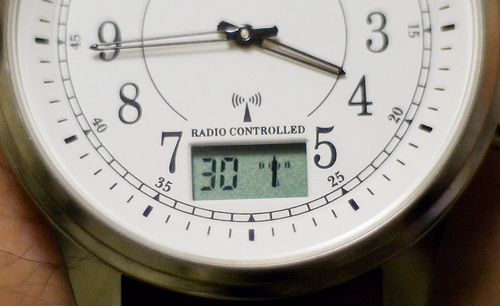
For me, the first truly useful smart watches were the radio controlled ones that synchronised to the
atomic clock using a signal beamed out from London, Frankfurt or a host of other world locations.
 |
| Atomic clock synchronised watch |
Unfortunately, my adopted country hasn't harnessed the benefits of precision timing for the masses so we can't use this functionality here but radio-controlled watches and clocks have been a big hit with consumers lucky enough to be in range of the signal. They're not even considered that special anymore. Every home weather centre or
Oregon Scientific alarm clock can also use this technology, if the signal is there.
 |
| Pulsar calculator watch |
In the 1980s calculator watches were a geeky fad for the blink of an eye but they didn't really catch on. For me they fell into the same category of unnecessary purchases as the
Sinclair C5 did. They make the user a source of ridicule and, be honest, who wants to look stupid?
Enter a new breed of smart watch for today. From what I can glean about the
Pebble, the watch itself doesn't actually need a whole heap of technology. It seems to be primarily a satellite display and alarm function for the tethered smartphone in your pocket. Rather than constantly playing with your phone or carrying it in your hand while exercising the watch can provide you with a scrolling feed from your email, Twitter feed or news ticker. If the user wants to, he or she can be always connected without being overtly focused on that pesky smartphone. High technology that tries to be discreet rather than in your face. Not everyone wants to be seen with their head in their phone so this device may well appeal to those who have not totally sacrificed social skills to technology.
 |
| The Pebble watch |
Pebble inventors faced a common issue for start-ups - no funding, so they followed a modern trend and
crowdfunded their capital through
Kickstarter. Clearly there's some faith in the Pebble watch concept because they quickly gained offers of far more money than they actually needed to get going.
The technology that makes the Pebble possible is also something of an Achilles heel. Any transmitting device faces a raft of compliance demands particularly around aircraft of medical equipment. Add to this the dangerous distraction this could be for drivers and Pebble have some real safety challenges.
Pebble has some serious competition from other start-ups and some big players too so it a bit early to know where this will lead.
I'm not part of their target demographic as I don't want to be 'on' to this degree. The watch is also much too big for my wrist but it does have more style that one might expect.
 |
| The i'M watch |
Finally one spin-off from this interest in wrist tech. People may once again start to wear wristwatches, a fashion that's been in steady decline since we discovered the mobile phone.
11 high tech watches you can buy
Tech watch reviews
Smart watches (Stuff article)