Showing posts with label trend. Show all posts

Sunday, 28 April 2013

Death of the Netbook

       Is it death throes for the netbook in the age of tablets?      
According to this Stuff article, netbooks are on the brink of extinction. Most people may not be aware of this, I guess because they have long since stopped buying them.

What is a netbook?

Well, the term has always confused me and I doubt I'm alone in this.  When netbooks first became fashionable accessories they tended to have a maximum screen size of 10", 1 or  maybe 2GB of RAM, no optical drive and a pretty low resolution screen and graphics capability.  They often ran Windows XP (Vista was a dog so they fell back to the old faithful).  Some ran Linux but that I think was more to keep the price down.

They were popular because they gave people access to surf the web when away from home plus they had a keyboard that made elementary word processing and email tasks not too onerous.  No-one ever expected them to be your first or only choice of computer - they were very much a carry-around websurfer.

New kids on the block

All hail the conquering tablet
So what happened?  Well, the tablet came and blasted them out of the water.  Check the boxes of the netbook versus tablet and it's not hard to see why.  Both will let you surf the web, email, Skype, and store documents and pictures.  But consider what else the tablet can do and it's obvious why netbooks have had their day.

Is the chromebook a worthy successor?
If a tablet's not your thing, perhaps a worthy successor to the traditional netbook is the chromebook.  Like the netbook, this device is limited in power with a very basic hardware configuration.  It relies on its internet connectivity to use the Google Chrome operating system environment to provide all its applications and storage from the 'cloud'.

The market supports plenty of small portable notebooks that are considerably more capable than the netbook ever was. Indeed, some of today's ultrabooks have amazing specifications and a price to match.

Sleek sexy ultrabooks are a long way from the netbook
The netbook was a short love affair but one that I fear will soon be forgotten with just a very small entry in the annals of computing history.

Cheap netbook on the brink of extinction (Stuff)

Sayonara netbook (Guardian UK)

Death of the netbook (LoF)

The ASUS eeePC (Wikipedia)

The Netbook (Wikipedia)

Tuesday, 2 April 2013

Fading Facebook

Adapt or die

Instant gratification apps
A fascinating article on Mail Online today, talking about how teens are migrating to messaging apps like WhatsApp, Kik and WeChat rather than hanging out at Facebook.

I guess the social response is all that more instant with these apps - really interactive.

Will we see a Facebook phone?

02/04/2013 

I'll be watching with interest when Facebook reveals its big announcement later this week.  It's rumoured to be an HTC Android phone with Facebook more integrated into the OS but we'll have to wait and see.

One thing's for sure - if our teens find a new place to meet online with their friends then Facebook will need to adapt or die.


06/04/2013

As predicted, Mark Zuckerberg delivered on the rumours and revealed the new Facebook-focused HTC
Phone with Facebook Home
phone at a eagerly anticipated launch this week.  Zuckerberg stresses that it's not a Facebook phone - it's 'people-centric' - something that Microsoft et al would do well to heed.

Facebook phone unveiled (Mashable)

Facebook Phone a triumph of mediocrity (Forbes)

Lessons for Apple from Facebook phone (CNN Money)

Is Facebook Home a bit of a turkey (NZ Herald blog comment)

A possible bone of contention for Google is the way that Facebook Home displaces Android at the heart of the phone, placing it a rung above all apps running on the device.  Someone's not going to be happy about that.

Instant Messaging Links

How it works - Instant messaging

Line-up of Instant Messaging smartphone apps


Sunday, 31 March 2013

The world in 2020


I've just been watching the predictions for the world by 2020 - a fascinating slideshow posted on this World by 2020 presentation (YouTube)

What's in store for us by 2020?
Very interesting slideshow with a wide range of technology featured and social impacts based primarily on our failure to address environment concerns (extinction of animals in Africa, humanitarian crisis in southern Asia, etc).

2020 is slightly earlier than my 10 year range of 2023 but it certainly filled me with hope that I'm are on the right track.

In the video I saw a number of medical advances - cures for disease, use of nanobots entering the operation arena.

They also featured a probe that would enter the sun's atmosphere - did I understand that bit correctly?  If this is going to happen we are going to need some radical new materials that can withstand unbelievable levels of heat (not to mention the ability to travel 90 million miles - when will it need to leave earth?)

There were predictions on a number of tech fronts - sending messages by thinking (careful what you think !!), textiles that use processes from nanotechnology.

I think the connected user figure was 5 billion but I'll need to replay to check that.  Clearly that's a huge number but according to the world population forecasts we'll have 8 billion people on the planet so that's only just over 60%.

Anyway, I'm going to watch this one again, plus a few others as I think these provide good validators for my current thinking.  It's certainly no simple matter being a future gazer, even with all this excellent help from fellow futurists.

Predictions for 2030

Take a look at this prediction for what the world may look like by 2030.

Thursday, 28 March 2013

I've been thinking


Separate technologies or strands of something bigger?

Recently I constructed a top 10 list of predictions for the next 10 years - a pretty tall order for a novice like
Rodin's The Thinker
me but it was both fun and challenging to do this piece of future-gazing.  Having identified a short list of 10 trends and technologies I will now attempt to whittle that list down to just 5.

In order to do that I'm going to have to eliminate some  (which seems pretty harsh) or maybe I should try something else.

As I've ruminated on my list of trends I've noticed something very interesting.  There are so many strands of each that intersect with other trends on my list.  I guess it's hardly surprising that these technologies are not operating in isolation of each other.  That makes a lot of sense really - unless something is truly restricted and set apart from the rest of the world order, how could it not have some synergies or relationships with other trends?

Having recovered from this 'eureka' moment I feel energised to start this task of rationalisation.  What will be on my Top 5 list is yet to be decided but I feel confident that at least some of those 5 trends and technologies will contain strands from others on my original Top 10 list.

It's going to be an interesting journey.

Wednesday, 27 March 2013

The power of the written word


This time I'm thinking about substitution of technology - how different some basic processes are now to "when I were a lad".  What do I mean by substitution of technology?  We're talking here about a customer adopting one product over another due to its technological superiority.

We've seen this effect countless time in consumer technology products - CDs superseding LPs and cassettes, Blu-ray (hoping to) supercede DVDs, etc, etc.

What I want to look at today is something that is so far removed from yesteryear that it's almost unrecognisable.  Unlike the media examples I quoted above this is an essential skill that we all need to.  The technology for achieving it has changed but the basic skill remains the same - I'm talking written communication.

I'm not referring here to commercial or business communication.  What I'm talking about is how would I use the written word to keep in touch with, say,  cousins in Scotland or a German pen pal (remember those?).

Let me step back in history to another life to describe how this was done in my youth.

A blast from the past, Parker Quink
I had the misfortune to spend my teenage years in a rather grim English boarding school.  Every week we had to write two letters, under supervision of a sadistic prefect.  These letters could be to anyone but it was expected that if you had parents, one of those letters would be addressed to them to tell them what a spiffing time you were having.  Letters were to be no less than 2 sheets of writing paper (both sides to be used) and all writing was to be neat, in ink (no biros) and grammatically sound.  If you made a mistake there was this wonderful new invention called 'Tippex' to rectify the error.  It didn't matter what you had to say or how little worth repeating had actually happened since last you wrote, 4 sides of paper for each letter, no excuses.  There was an hour set aside for this task so there was plenty of time to read, check and correct whatever scintillating news you managed to dream up.

Schooldays letter-writing nightmares
Fast forward to now and ask, would anyone use such a victorian approach to communicating with loved ones?  Most likely you would actually call them by phone, mobile phone or you might Skype them for both audio and video exchange of news.

Even if you do still write long hand to friends, you would most likely use email to make this happen.


Think about the advantages that the modern writer has over the reluctant schoolboy from yesteryear . . .
Post box


  • I can type considerably faster than I can write
  • Legibility is never an issue so long as I don't choose a weird font
  • Formality has largely disappeared so the tone of the message is likely to be far more fun and less likely to send the recipient to sleep
  • If I am as precious about grammar and spelling as my masters were, well hey, there's an excellent grammar and spelling checker built in to the email client (yes, I know that's cheating but I haven't bought a new dictionary for 15 years)
  • I can write the same basic message once, then clone it with minimal change for as many recipients as I choose
  • Email has much greater immediacy than pen and paper - tell them what's going on today, not what happened weeks ago
  • Chances are that there's a photo, news story or video that's relevant to include in the email.  Send out a link to provide multimedia support for your words
  • Stamps are getting expensive, and good writing paper ain't cheap either.  Eliminate these by sending an email for virtually no cost at all
  • Use all that time you saved from not writing a formal letter to do something fun.
Maybe the biggest loser here is your dog, who no longer gets his morning walk to the post box, since you only use the 'snail mail' system once in a blue moon.

Fountain pen nib    
Personal communication through the written word has changed so dramatically over the last 15 or so years that it's virtually unrecognisable from what I remember.  The convenience of email, instant messaging, blogging and text messaging leaves traditional methods for dust.  Electronic mail surpassed letter writing many moons ago for most people living in a modern world.  The email technology itself is now somewhat long in the tooth but is still serving us very well indeed.

I don't miss writing long hand, especially under the nonsense rules of my schooldays.  There is though one thing I do miss - I loved to write with my Parker fountain pen.  I wonder if there's a font that replicates the look of pen strokes made with blue-black Quink?

Sunday, 17 March 2013

Next10 and robotics


The Next 10 Years: Robotics

What is this technology?

Robotics is the diverse field of technology concerned with the design, development and constructions of robots.

Again, this technology is not new but what is happening in the robotics arena is nothing short of groundbreaking.

So where will it go next?

What will happen?

Arnie as the Terminator

We're not going to see the cyborgs of Hollywood heroes like the Universal Soldier or the Terminator in the next 10 years but we will see an explosion in the robotics arena, with ever increasing applications in the industrial, military, medical, and domestic sectors.

Robotics research is overcoming many of the barriers that have previously slowed progress.  Static robots employed in factories are already sophisticated but their cousins that need to move like a human or an animal over uneven terrain have struggled.  Projects like BigDog are showing that these challenges are being overcome and robots can move out into the wild (let's hope they don't turn feral).

Watson supercomputer at the heart of Blue Brain project
Teaching robots to think seems like a daunting challenge but projects such a Blue Brain (IBM's attempt to reverse engineer the human brain) will move robots from unthinking slaves to reasoning, problem solving, human-like entities.

The military applications are both exciting and frightening.  Rather than endanger their men and women, military powers will send in robots to do this work.  More sophisticated drones will develop to spy on and terminate threats without the need for human pilots or gunners.  Unlike today's drones that move at an almost sedentary pace, ultrasonic speed will send these agents of death to their targets in minutes, wherever they are in the world.

Robots will assist or even replace surgeons for performing the most intricate or surgery.  Metal scalpels will be consigned to the scrapheap as lasers make incisions and nanobots heal tissue and organs without the trauma of invasive surgery.

Robots will remove much of the grunt work from geriatric and invalid care and may even provide companionship for lonely souls.

How will this impact society?

Robots have long been employed in industry building cars, computer circuit boards and a multitude of precision instruments and our dependence on robots for engineering will continue to increase

Cylon centurion (Battlestar Galactica)
Robots will begin to enter the domestic sphere through labour saving devices in the home.

Medical equipment (MRI, CAT) will be rolled out in more hospitals and clinics and will become more affordable.  Use of these robotic wonders will become routine for early diagnosis of illness rather than detection of more developed problems.

Military operations will partner robotic machines to perform aerial and terrestrial insurgence to enemy positions to transmit detailed surveillance information.  Targeted attecks aginst the enemy by aerial drones and robotic successors to present-day tanks will reduce enemy defences to shreds.  Human forces will only be sent in to areas where enemy positions are already decimated.  The loss of life on the technologically equipped side will be minimal whereas the opposing side will be virtually eliminated.  With the odds of success heavily weighed against them only psychotic commanders would take the offensive against a technologically superior opposition.

Cylons will not have destroyed the earth or enslaved its inhabitants within the next 10 years !


What supports this prediction?

Reverse engineering the human brain

Riba the Robo-nurse

Nanorobotics

Robot wall climber

Hypersonic travel

Saturday, 16 March 2013

Pebble dash


007 Casino Royale
Smart watches.  They've been around for as long as I can remember.  007 has had all manner of smart watches for the last 50 years.  Some of them contained wire to saw through metal bars or for abseiling out of a tight situation. Others could print out a ticker tape a message from M or Q.  These were simply fun props for movie excitement but the modern smart watch really works.

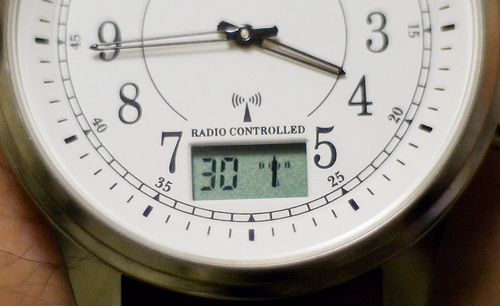
For me, the first truly useful smart watches were the radio controlled ones that synchronised to the atomic clock using a signal beamed out from London, Frankfurt or a host of other world locations.

Atomic clock synchronised watch
Unfortunately, my adopted country hasn't harnessed the benefits of precision timing for the masses so we can't use this functionality here but radio-controlled watches and clocks have been a big hit with consumers lucky enough to be in range of the signal.  They're not even considered that special anymore.  Every home weather centre or Oregon Scientific alarm clock can also use this technology, if the signal is there.

Pulsar calculator watch
In the 1980s calculator watches were a geeky fad for the blink of an eye but they didn't really catch on.  For me they fell into the same category of unnecessary purchases as the Sinclair C5 did.  They make the user a source of ridicule and, be honest, who wants to look stupid?

Enter a new breed of smart watch for today.  From what I can glean about the Pebble, the watch itself doesn't actually need a whole heap of technology.  It seems to be primarily a satellite display and alarm function for the tethered smartphone in your pocket.  Rather than constantly playing with your phone or carrying it in your hand while exercising the watch can provide you with a scrolling feed from your email, Twitter feed or news ticker.  If the user wants to, he or she can be always connected without being overtly focused on that pesky smartphone.  High technology that tries to be discreet rather than in your face.  Not everyone wants to be seen with their head in their phone so this device may well appeal to those who have not totally sacrificed  social skills to technology.

The Pebble watch
Pebble inventors faced a common issue for start-ups - no funding, so they followed a modern trend and crowdfunded  their capital through Kickstarter.  Clearly there's some faith in the Pebble watch concept because they quickly gained offers of far more money than they actually needed to get going.

The technology that makes the Pebble possible is also something of an Achilles heel.  Any transmitting device faces a raft of compliance demands particularly around aircraft of medical equipment.  Add to this the dangerous distraction this could be for drivers and Pebble have some real safety challenges.

Pebble has some serious competition from other start-ups and some big players too so it a bit early to know where this will lead.

I'm not part of their target demographic as I don't want to be 'on' to this degree.  The watch is also much too big for my wrist but it does have more style that one might expect.

The i'M watch
Finally one spin-off from this interest in wrist tech.  People may once again start to wear wristwatches, a fashion that's been in steady decline since we discovered the mobile phone.

11 high tech watches you can buy

Tech watch reviews

Smart watches (Stuff article)

Crowdfunding your way to success

Veronica Mars is headed for the silver screen thanks to the fanbase
Not so much a technology as a trend that I'm sure is here to stay, crowdfunding is all about raising venture capital from your end consumers.  Crowdfunding start-ups like Kickstarter are already big players themselves and there seems no shortage of people lining up to support good ideas.

Pebble is a Kickstarter success
For a small outlay you can help get a good idea out of the garden shed and into the retail store or onto the silver screen.    Whether it's a net-connected watch or the movie version of a favourite TV show, creators will know early on whether they're headed in the right direction because fans can now vote with their wallets.

In 2012 Pebble reckoned that they needed $100,000 initial funding and they achieved that in just 2 hours on Kickstarter.  Such was the level of interest that Pebble closed the pre-order list 30 days early having being pledged $10,266,844 from 68,928 people.       The tech of Pebble (Mashable)


Cult TV show Veronica Mars made an international star out of actress Kristen Bell and ran for 64 episodes over 3 full seasons. Fans were devastated when the show was cancelled.  There has been talk ever since of a movie but it's never managed to get the funds together - until now.  The Veronica Mars project on Kickstarter is breaking all sorts of records.  In just 4 hours they had smashed through the $US1 million mark.  Astounding.  Kickstarting Veronica

Crowdfunding projects bring hope to big dreamers all around the world.  For me, this is a game changer that  will see the public actually getting what they want, not just what big business wants them to have.

http://www.stuff.co.nz/technology/digital-living/8468665/Veronica-Mars-rattles-movie-industry

Tuesday, 5 March 2013

10 years on

Could you predict the next 50 years for technology innovation?  No, how about the next 10?

Only 10?

10 years is surely still a big ask, isn't it?

OK, we're a bit more realistic than when Star Trek hit our screen and we know that we're not going to reach warp speed any time soon.  Are we ever?

In the home 10 years we will have already lived through a communications revolution.  Unlike now where I'm sitting anchored at my desk in my dedicated study typing onto a keyboard and looking at fixed screen, I'm not going to be doing that.  I'll be talking to someone, anyone, anywhere in the world while I walk around, doing a hundred and one things (just like I curently do when I'm on the phone).

Unlike now though, cameras mounted throughout the building will automatically detect my presence (if I want to be on camera) and will allow me to move around freely.  Those images will be mixed and transmitted to my friends through a link that is so much faster and capable of such enhanced bandwidth that the images can be as high definition as required, no lag, no jerky movement, crystal clear audio and overlaid with any other text or images I want to send simultaneously.  I'm not restricted to a single feed either.  Every one of my family could be doing the same as me and we could still have the neighbours around to try unsuccessfully to eat up all that capacity.

We'll have video displays all over the house - on walls, on tables.  Displays so thin that they can be sited anywhere.  Displays that bend so you're no longer limited to flat surfaces.  Images projected onto any reflective surface will be commonplace.  Glasses that project the image before my eyes mean I can move anywhere I want without losing contact.

Voice command has replaced the need to type words and rhe haptic band on my wrist allows me to scroll an image with a simple natural movement.

Much of this technology is already here but it's expensive and takes a lot of installation.  In 10 years these will be mature, ubiquitous products that every developed nation has.

That's just the home communications - what else can we expect?